Noelle Swan

Author Archive

The Grand Champ of Women’s Boxing: A Massachusetts story opens the door to first-ever women’s Olympic boxing

In Civil Rights, Uncategorized on August 17, 2012 at 12:14 pm
Noelle Swan
Spare Change News
August 17, 2012

NORTH ADAMS, MASS. — In 1984, the U.S. Supreme Court’s first woman justice, Sandra Day O’Connor, was still a newbie. Astronaut Sally Ride had just become the first woman in space. And Gail “The Champ” Grandchamp wanted into the Olympic boxing ring.

She wanted it with all the ferocious energy that coursed through her fists.

That year Grandchamp (yes, her real name) took on the all-male boxing establishment and delivered the legal KO that opened the door to this summer’s first-ever women’s Olympic boxing competition.

This August, two of the three women on the American boxing earned medals. Flyweight Marlen Esparza brought home the bronze, and middleweight Claressa Shields won the gold. Neither of them would have made it to the London games if it weren’t for the little-known welterweight from North Adams, Mass., whose tenacity in the ring was matched by her determination to wage an eight-year gender-discrimination battle for her sport.

“If I could meet Gail right now, I’d probably give her a hug, because she did a lot for women’s boxing,” said 17-year-old Shields in an interview after returning home to Flint, Mich. from the games. “I wouldn’t know how to go to court for women’s boxing. I just want to box.”

At the time, Grandchamp says that no one expected her to succeed in court. Five attorneys dropped her case, sure that she would never win, but she persevered—even after she knew she could never benefit from the outcome herself.

“They thought I would just go away, but I am a strong African American woman and I intended to fight for my rights,” roars Grandchamp from behind a tiny desk tucked by the window of her personal training studio in a rundown strip of storefronts in this western Massachusetts town.

Not only was Grandchamp deprived of her chance to go for the gold, she never even got credit for her historic battle to open the door to other female amateur boxers.

But in the style of a true champion, she refused to wallow in defeat. Instead, she drew on her childhood experiences with gangs and crime to become an inspiration to troubled youth in her community.

Today Grandchamp is gaining recognition by her community for her work in the two arenas of her life.

“She is such a force for girls to look up to,” said Gianna Allentuck, who invited Grandchamp to mentor young at-risk youth in her Springfield, Mass., boxing program, The Officials Club. Allentuck adds she inspires boys as well.
As a teen Grandchamp fell in with a gang, carried a switchblade, and committed thefts. She had many run-ins with the police and accumulated a lengthy juvenile record. While she was serving probation for stealing bicycles, clerks at a downtown department store caught her stealing a clock.

“My probation officer told my mother to pack my bags,” she recalls.

Expecting to be sent away to a juvenile detention center, she begged the judge for one last chance. The judge granted her wish, and Grandchamp changed her ways. She started paying attention in school and reading the Bible. She started playing softball and weightlifting. She says that it was through organized sports that she learned about self-discipline and how to be accountable for her actions.

“This lady was on her way to juvenile detention and got one more chance,” says Allentuck. “Our kids can relate to that. And she is tough and strong and resilient. She teaches them to be a good person, to have dignity, to have integrity, and definitely, never give up.”

People who know Grandchamp’s story are moved by her selfless determination.

“You can only talk about her heart, because it’s just huge,” said Allentuck. “She did this for other women. She’s the reason that these young boxing women are in the Olympics today.”

Last spring the Massachusetts legislature recognized Grandchamp for her “dedication, devotion, and achievements in leading the fight for women and women’s boxing,” as part of a celebration of women’s history in sports.

“I think that her commitment to following her passion has shown countless women that just being told that you can’t do something because of who you are isn’t an acceptable answer,” said state Senator Benjamin Downing of Pittsfield. “She has absolutely been a role model and a pioneer for women, not just in boxing, but in all sports.”

“Gail Grandchamp’s positive force and passion in promoting gender equality in sports is still being felt, especially as women’s boxing makes its Olympic debut,” said Massachusetts Attorney General Martha Coakley, who grew up in North Adams. Coakley hosted Grandchamp during a visit to the Massachusetts State House in Boston. “Gail is an outstanding role model for young women, and her determination encourages women to stand up and be strong both in and out of the ring.”

Grandchamp is still waiting to get this kind of recognition from the boxing world.

The woman who generally gets the credit as the women’s boxing trailblazer is Dallas Malloy, a blonde light welterweight from Bellingham, Wash., who, armed with attorneys from the American Civil Liberties Union and Grandchamp’s crucial precedent, challenged USA Boxing’s bylaws in federal court. The judge approved an injunction within moments of hearing the case, and in 1993, at age 16, Malloy became the first woman to fight in a USA Boxing sanctioned event.

Grandchamp says that Malloy, who retired from amateur boxing after just nine months, has yet to publicly acknowledge that Grandchamp laid the groundwork for her historic fight.

“I fought for eight years for this. Nobody else fought that battle. Not Dallas Malloy. Not Laila Ali [daughter of boxing legend Muhammad Ali and now a famous fighter herself]. Not even a lawyer!”

Grandchamp described her historic journey in an interview at Grandchamp Fitness and Boxing, a personal training facility in North Adams that Grandchamp founded. The battle began in 1984, when her coach tried to register the 29-year-old with the New England Amateur Boxing Federation, a regional arm of the governing body now known as USA Boxing. The coach received a phone call from a puzzled federation official asking if Gail Grandchamp was a girl. Yes, he said, and one of his best boxers. The official replied that no female could register as an amateur boxer.

“He told him, ‘Don’t even bring her down here. There’s no such thing as amateur boxing for women,’ ” Gail recalls.

Devastated, Grandchamp vowed to knock some heads together, figuratively, and change their minds.

In January 1985, she filed a complaint with the Massachusetts Commission on Discrimination against both the regional and national federations. Feeling that the commission was not taking her complaint seriously, Grandchamp hired an attorney and filed a lawsuit against the New England Amateur Boxing Federation.

By the time she had her day in court, five attorneys had come and gone, including a lawyer from the National Organization for Women who resigned after deciding the case was unwinnable.

Grandchamp watched the birthdays go by as her lawsuit lumbered through the courts, until the hard realization dawned that the battle was not for her, it was for younger women who would follow. As the age limit for amateur boxing—36—slipped by, she gave up her personal dream of amateur boxing and reaching the Olympics. She registered as a professional boxer; but she continued to fight in court.

“I was doing it for all the other women boxers out there,” she writes in her self-published autobiography, Gail Grandchamp: A Fighter with Heart Pursues Olympic Dream. “My Olympic dream became an Olympic dream for all the aspiring women amateur boxers out there.”

Without any formal legal training, Grandchamp decided to represent herself and carry the case forward on her own.

“I had to be the whole football team,” she says, nearly vibrating in her chair. “I drove the ball. I stumbled, I fumbled, but then TOUCHDOWN!”

On April 26, 1992, the Berkshire County Superior Court ruled that the New England Amateur Boxing Federation’s ban on women’s boxing was discriminatory and illegal.

“That day I felt like justice is still here,” Grandchamp exclaimed, springing out of her chair and bouncing around her studio clapping her hands as she relived the victory. “Justice can still come in Massachusetts. It was just incredible that justice prevailed, even though I wasn’t an attorney!”

In the years that followed, Grandchamp refocused her energy on her community in North Adams, a small town in the northwest corner of Massachusetts where roughly one fifth of the population lives below the poverty line. She established the Fighter with Heart Foundation to help members of her community facing financial hardships. She markets a variety of products with her name and logo on eBay to fund the foundation and offer loans and grants to her neighbors needing help paying their utility bills, veterinary bills, and just making ends meet.

Twenty years after her victory, Grandchamp boarded a plane for Spokane, Wash., to witness the first-ever women’s Olympic boxing trials. That trip triggered mixed emotions.

“I was ecstatic. I couldn’t wait to meet the girls,” Grandchamp recalled. “I cried because it’s like giving birth to something.”

On the other hand, those women were realizing the dream that she was denied. Everything she had ever worked for had finally come true, but she was relegated to the sidelines.

“That was hard,” she says quietly. “That was my dream.”

Even more shocking was the realization that the 24 women competing for slots on the first-ever U.S. boxing team had no idea who she was or how hard she had fought for them to be there.

“Most of them don’t even know that there was a time that women couldn’t box as amateurs at all,” Grandchamp said sadly.

Twenty-eight-year-old Olympic hopeful Tiffany Hearn of San Diego had participated in recent petition drives to bring women’s boxing to the Olympic games, but had no idea who had started that fight, or that it had begun when she was just an infant.

“I hate to admit that,” she said. Hearn explained that after meeting Grandchamp at the Olympic trails in Spokane, she and the other girls started asking the older coaches about her and started to piece together her story.

Another Olympic contender, Traversha Norwood of Atlanta, said that although she had talked with Grandchamp, she did not learn about Grandchamp’s role in the history of women’s amateur boxing until after the trials.

“I sat down with her and my coach. It wasn’t about her. She was making it all about me, seeing how she could help me and how to promote myself,” Norwood says. “I didn’t realize the importance of the moment until afterwards.”

Shields laments the fact that many of her peers are unaware of what Grandchamp did for women’s boxing. “That’s like not knowing the name Ali,” referring to former heavyweight champion of the world, Muhammad Ali. “You can’t live in the past, but you have to know where you came from.”

The world watched on as three American women competed for Olympic gold, but few knew that the arduous journey to the Olympic arena began before those women were born.

Grandchamp watched the historic bouts on television at home, cheering on the sidelines once again.

Training Program Helps Refugee Farmers Establish Urban Farms in their New Homeland

In Food Security on August 14, 2012 at 11:59 am
Noelle Swan
Seedstock.com
August 14, 2012

In 1998, a group of Cambodian immigrants and former farmers living in the economically depressed city of Lowell, Massachussets reached out to Tufts University for help. Their objective: to learn the business side of farming. Out of this request emerged the New Entry Sustainable Farming Project, a partnership between Community Teamwork, Inc. – a community action action agency based in Lowell, MA – and the Tufts University Friedman School of Nutrition.

Immigrants have flocked to Lowell since the days of the mills. Once hailed as the cradle of the American industrial revolution, the city fell into a deep depression with the collapse of the New England textile industry nearly a century ago and has been trying recover ever since.

In recent decades, the city has become a safe-haven for refugees fleeing their war-torn homelands. Today nearly a quarter of residents were born in another country and 40% of residents speak a language other than English at home, according to recent census data. The majority of these immigrants come from rural farming communities in Southeast Asia and West Africa.

To help these refugees leverage their farming skills toward the end of achieving economic self-sufficiency and prosperity, Tufts University developed the New Entry Sustainable Farming Project to provide them with the tools necessary to establish new urban farms, create their own farming businesses, and capitalize on the rising local food movement.

Today, New Entry welcomes both immigrants and American-born students from socially and economically disadvantaged backgrounds around the Merrimack Valley, says Kimberly Fitch, program and finance coordinator. Tuition is determined by a sliding scale, ranging from $80-$500. Over the years, the program has evolved from solely teaching business skills to experienced farmers to today providing hands-on training for new farmers and assistance in starting their own independent farms. “We find that the people who have been with us the longest and shown a tremendous commitment to this are the folks who have farming in their blood stream,” says Fitch.

Prior to enrolling in the program all students first take a two-hour long exploratory course, which offers prospective students an overview of the program and encourages them to reflect on whether or not farming might be right for them. “Farming is really hard work. Not only does it take some desire, it also takes a lot of skills,” explains Fitch. “It takes time and a really, really deep sense of commitment. People might realize partway down the road that it’s not the right direction for them.”

Students can choose to enroll in just one training program, a series of trainings, or engage in a career-long relationship with the program through a community supported agriculture (CSA) program. The flagship course, first offered in 2004, focuses on farm business planning. Instructors walk students through writing a business plan, creating budgets, indentifying markets, researching materials and equipment, and developing a crop plan and schedule. This class is also offered as a distance-learning course for students that are unable to attend class in person. Students can take a series of field workshops that teach specific skills from building raised beds, to managing insects and weeds, to post harvest handling. The program exclusively teaches organic practices. Additional courses are available in livestock and poultry management.

Students who have completed the farm business-planning course have the opportunity to lease a plot of land on New Entry’s training farms in nearby Dracut for up to three years. New Entry charges training plot farmers just $675 per acre per year and offers tenant farmers individual technical assistance as well as access to equipment, refrigerated storage, and organic pest management supplies. After three years, the program helps farmers find their own land in the area and transition to independent farming. While most students that enroll in New Entry want to have their own independent farm, the program does offer resources for finding jobs on existing farms around the Merrimack Valley.

Since 2005, over 60 farmers from 15 different countries have graduated from the program from. “For a number of our immigrants what they prefer to grow is what’s familiar to them,” Fitch says. The New Entry website features profiles of several farmers that grow crops from their native country, including amaranth, long beans, Japanese eggplant, bitter melon, hard-kernel corn, and water spinach. Many graduate farmers market their produce through New Entry’s World PEAS CSA even after moving onto their own independent farm sites. Member CSA boxes typically contain half standard crops grown by local farmers and half ethnic crops grown by New Entry graduate farmers.

New Entry is physically removed from Tufts University’s main campus in Medford, but it maintains a strong connection to the university and the Friedman School of Nutrition Science and Policy. A handful of students from Tufts University have taken the online version of the business-planning course. One student returned to the program as a distance-learning instructor. Students from the Friedman School can opt to work on the farm as a work-study project. Fitch says that this year a graduate student will be working in the field as the assistant to the technical assistance coordinator.

Funding for the program comes from a broad range of sources and agencies within the USDA. Private foundations, CSA-memberships, and individual donations provide additional funding. As similar organizations have popped up around the country, securing funding has grown a bit more challenging, says Fitch. However, she adds that New Entry strives to support other organizations, offering ideas around best practices, posting learning opportunities, and hosting groups interested in seeing what New Entry has done first hand. “We are providing templates that describe how we operate and how we have grown and evolved over the years,” she says.

Looking forward, Fitch says that she and her colleagues are looking to grow New Entry’s existing programs. “It’s important that we have as much impact as possible.” She adds that she sees growth potential in the distance learning program and hopes to further develop a fledgling national technical assistance initiative.

Testing, Testing…HIV: Taking the Stigma Out of AIDS Testing

In Healthcare on August 10, 2012 at 1:52 pm

This article first was published by Spare Change News on August 10, 2012.

“College-educated black women who live in the suburbs and date lawyers don’t get HIV and AIDS. This just doesn’t apply to you,” Kimberly Wilson remembers her doctor saying back in 2004.

That was the first time she asked her physician for an HIV-test.

Four years, seven bouts of shingles and five requests for an HIV-test later, Wilson was admitted to Boston Medical Center. She had stopped in hoping to get some prescription cough syrup. Emergency room doctors ordered a chest X-ray.

“The technician who took the X-ray of my lungs thought the machine was broken, because the lung was so black, ” Wilson recalls.

The machine had not malfunctioned; Wilson’s lungs were coated with thrush, a yeast infection common among patients with compromised immune systems. Soon, she was diagnosed with Pneumocystis carinii pneumonia (PCP), an opportunistic infection commonly associated with HIV.

Four years after she first requested an HIV-test, Wilson learned that she was HIV-positive. Today, she manages her condition through a myriad of medications and describes her health as excellent. But she believes that an earlier diagnosis could have eliminated years of pain and suffering.

Since her diagnosis, she has become a self-described poster child for HIV-testing, working as a peer advocate for AIDS Action, routinely sharing her story with the media and serving as a delegate at a recent international conference on AIDS and HIV in Washington, D.C.

“I think everybody should get an HIV-test,” she says. “It should be part of your physical. It should be a part of your whole entire care.”

Recent Massachusetts legislation targeting consent requirements for HIV-testing aims to normalize the process and potentially improve testing rates.

Until last month, state law required that patients interested in receiving an HIV-test had to sign a form giving written informed consent. The new law allows patients to provide consent verbally in a move that doctors, advocates and policymakers hope will normalize the process.

According to the Centers for Disease Control, over 1 million Americans are living with an HIV-positive status. However, as of 2006, one in five of those patients were unaware of their condition. In response to this data, the CDC issued new guidelines for the management and care of HIV, calling on states to streamline the testing process.

Many physicians and advocacy organizations in Massachusetts, such as the AIDS Action Committee, have petitioned the state Legislature to remove the requirement for written informed consent, which they consider to be an unnecessary hurdle for testing.

“Many states early on had this [requirement for written consent] because of the discrimination and stigma surrounding HIV, but also because in early years it was a death sentence,” explains Rebecca Haag, President and CEO of AIDS Action Committee in Massachusetts.

In recent years, HIV treatment protocols have improved dramatically. Many patients with an HIV-positive diagnosis are able to successfully control their condition with medication and do not develop AIDS. Wilson’s story illustrates how effective treatment can be, once the diagnosis has been confirmed.

“HIV testing has been encumbered for about 25 years, since we first developed the tests in 1984,” says Stephen Boswell, President and CEO of Fenway Health in Boston and former HIV policy advisor to the Clinton Administration.

“Over the years, [written consent] has been felt by many clinicians to be more and more of an impediment to people’s willingness to be tested,” Boswell says. “Not only did it continue to stigmatize the patients but made the testing process more complicated.”

By removing the formality of written informed consent, legislators and physicians hope that HIV-testing can become part of routine conversation between patients and their doctors.

“Patients will still be informed of what the test means, they will not be tested without their knowledge and they have the right to opt out or opt in of getting tested, but it won’t add paperwork to that process,” says Rep. Carl Sciortino (D) of Medford.

Once an HIV-positive diagnosis has been confirmed, strict laws govern how that information can be shared with other providers.

“If a patient has an HIV-positive result, their test results cannot be shared with anybody else without their written informed consent; and I think that’s for good reasons,” explains Sciortino.

Boswell recognizes the need to protect patients’ privacy. However, he worries those strict requirements for sharing information could compromise patient care.

“For example, if my patient is seen at an ER, I could not relay any HIV testing information without first obtaining the written informed consent from the patient who might be unconscious,” he explains.

Boswell says that while he and his colleagues are celebrating the removal of one impediment to care, they are left struggling to understand what is required of them in terms of sharing information in the age of electronic records.

“Most of the institutions are struggling to figure out how to comply. If we have to get written informed consent every time we ask another clinician for assistance, it would dramatically complicate the process of providing care to patients who are HIV-positive.”

In the final days of the 2012 legislative session, Sciortino sought to address this issue by adding language into the health care payment reform law that allows patients to extend overall consent to information sharing. The health care payment reform law placed heavy emphasis on the use of electronic medial records to streamline healthcare. However, Sciortino’s language did not make it into the final wording of the bill signed by Governor Patrick earlier this week.

UD Apiary research aims to take sting out of nationwide bee colony collapse

In Honeybees, Wildlife and Ecology on August 2, 2012 at 1:56 pm

This article first was published by WDDE.org, Delaware’s NPR News Station on August 2, 2012.

Bee colonies across the country began mysteriously collapsing in 2006, and have had scientists urgently seeking a cause of the meltdown ever since. Now, researchers at the University of Delaware believe they’ve uncovered clues to solving this problem that threatens the delicate natural balance on which the nation’s food supply depends.

At UD’s Newark apiary, where 22 hives are home to more than 1.3 million bees, researchers are focusing on an invasive parasite that can be as devastating to a bee colony as its Latin name, Varroa destructor, implies. The mites are one of several culprits that may be combining to cause Colony Collapse Disorder, which has resulted in the die-off of tens of billions of bees nationwide.

Debbie Delaney, a UD assistant professor of entomology and wildlife ecology, says combating one possible source of the decline might be as simple as mimicking a bee’s natural behavior, at least for small-scale beekeepers like the 300 apiarists in Delaware who host the majority of the state’s honeybees in their backyards.

While State Apiarist Robert Mitchell describes the status of the honeybee population in Delaware as “adequate,” he adds that colony losses have taken a toll at a time when the demand for pollination services continues to grow.

“Honeybees are responsible for the pollination of $10 million worth of wholesale fruit and vegetable value in the state,” said Secretary Ed Kee of the Delaware Department of Agriculture in an email reply. “This valuable resource must be protected.”

UD Apiary research aims to take sting out of nationwide bee colony collapse
Various stages of varroa mites.
Photo by Zachary Huang, http://cyberbee.net/gallery.

The varroa mite is one of the “primary forces behind the decline of the honey bees,” said Katy Evans, a UD graduate student spearheading Delaney’s study.

These little external parasites attack both adult honeybees and their brood, or young, by latching onto them and feasting on their blood. That may sound familiar to people used to swatting at mosquitoes, but varroa mites are no minor nuisance.

Although we can just barely see them with the naked eye, Delaney explains that it is a whole different story from a bee’s perspective.

“It’s as if we had a dinner plate attached to us sucking our blood,” she said.

To get to that blood, mites have to penetrate the bee’s exoskeleton, leaving behind a wound that is open to infection from additional pests and pathogens. When feeding on drones, or male bees, the mites deplete the drones’ protein and sperm levels and eventually render the bee incapable of flying. In addition to feeding on drones, the mites attach themselves to the brood of young bees in the early stages of their development.

“To make it even more awful, they vector viruses,” Delaney added. Just like a mosquito carrying malaria, or a tick bearing lime disease, these mites can transport and deliver new diseases directly into their hosts’ bloodstreams.

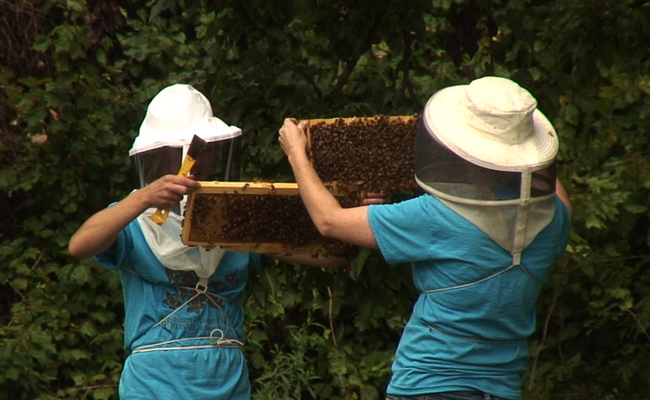
Delaney’s research at the UD apiary stems from observations she made in her backyard hives. So far, her bees have been healthy: no signs of virus, good honey production, and a strong population. She says that some of her bees have varroa mites, but they haven’t damaged the colony overall. She believes that the few mites on her bees at home have not had a chance to multiply because she employs a technique called hive splitting, which is modeled after bees’ natural tendency to swarm and establish two separate hives if their population outgrows the hive.

UD Apiary research aims to take sting out of nationwide bee colony collapse
Bee larva with 5 varroa mites on one side.
Photo by Zachary Huang, http://cyberbee.net/gallery.

Delaney is currently testing a theory that some natural beekeepers have claimed for years. During a hive-splitting period, bees don’t reproduce, and varroa mites have no baby bees to feed on. So the mite population dies off and takes so long to rebound that they never achieve numbers large enough to harm the colony.

Bill Leitzinger, amateur apiarist from Middletown and president of the Delaware Beekeepers Association has used the hive-splitting technique to control varroa mites in his hives for ten years. Leitzinger says when he was growing up, his father used chemicals to address mites and other problems around his few hives. He decided to do things differently.

“I have never used chemicals,” he said. “It used to be I was the weird one. Now most beekeepers are trying not to use chemicals.” He noted that the natural beekeeping movement evolved in response to research showing that chemicals applied to the hive can seep into the wax and remain in the hive for several years.

Delaney points out that miticides are not the only chemicals that remain in the wax. Pesticides and fungicides applied to plants miles away can stick to honeybees’ bodies during nectar collection and hitch a ride back into the hive where they, too, remain in the wax for years to come.

Recent research indicates that insecticides and parasites in non-lethal amounts can have a combined effect that becomes lethal. Delaney speculates that the combination of miticides and insecticides could have a similar effect. She hopes that her research will confirm that hive splitting is a viable alternative to chemical miticide application.

“If we can reduce in any possible way any type of pest that gets into the hive matrices or that the bees come in contact with, then I think that’s a very good thing,” Delaney said.

The Rise of Women’s Boxing: From Local Gym to Olympic Arena

In Civil Rights, Uncategorized on July 27, 2012 at 3:38 pm

This article first was published by Spare Change News on July 27, 2012.

Photo Credit: Tommy Chevalier

Noelle Swan
Spare Change News

No sooner had the bell rung than Jamie Jacobsen’s fist connected with my nose. Instantly, my eyes welled up with water and a cold chill set in all over my body. By the second round, my nose had swelled up beyond utility, leaving me struggling to learn how to breathe through my mouthpiece.

I staggered through three rounds, eating more punches than I care to remember and wondering what had happened to my two years of training. I bought an ice pop on my way home to soothe my throbbing bottom lip. Clinging to the bit of pride gained from seeing Jacobsen checking out her lip in the mirror after our sparring session, I vowed to myself that I would be back.

That was the first time I climbed into an official ring. More than a year later, Jacobsen and I faced off again, but more on that later.

Jacobsen and I are among a growing number of women who have turned to boxing for exercise and a competitive outlet. Next month, female boxers will contend for Olympic gold medals for the first time ever, at the 2012 summer games in London. Team USA fighters—22-year-old flyweight Marlen Esparza, 27-year-old Quanitta “Queen” Underwood and 17-year-old middleweight Clarissa Shields—will compete in each of the three women’s events.

The road to the Olympics has been paved with lawsuits and controversy even though women have boxed for more than a century. Women participated in a demonstration bout in the 1904 Olympics in St. Louis, the first modern-day Olympics to include men’s boxing events. It would be another 70 years before women’s boxing took the national stage again.

In the 1970s, Cathy “Cat” Davis became synonymous with women’s boxing. Major networks televised many of her fights, and in 1978 she became the first and only woman to appear on the cover of The Ring magazine. Her career ended after a formal investigation revealed that many of her fights had been fixed.

Through the 1980s the United States Amateur Boxing Federation, now known as USA Boxing, banned women from participating in sanctioned amateur fights until fighters Gail Grandchamp of Massachusetts and Dallas Malloy of Seattle sued for gender discrimination in the late ‘80s and early ‘90s.

The ‘90s brought Laila Ali and Jackie Frazier-Lyde, daughters of former heavyweight champions Muhammed Ali and Joe Frazier into the ring and American living rooms. Both went on to win world championship fights.

Women’s boxing has grown in popularity ever since, but has continued to meet opposition within the boxing world.

John Hazard, former coach of the U.S women’s national team, remembers taking his team to compete in Augusta, Georgia several years ago. He says he arranged for his team to work out at a local boxing gym while they were in town to prepare for the competition. When he showed up, the staff at the gym immediately stopped them. Hazard explained that he had called ahead and had been told that his team could train there, but he was quickly interrupted.

“ ‘Whoa, whoa, whoa, whoa! I was told a boxing team was coming. Nobody said anything about any women!’ ” Hazard remembers him saying while pointing to a sign barring women from the gym.

Today, Hazard and the coaches at his gym in Boston, The Ring Boxing Club, continue to work with female fighters, whether they are looking to compete, spar for fun or just get in shape. Vogue magazine just listed The Ring as one of the top five gyms in the country in which to learn to be an Olympic boxer. Women make up 40 percent of the membership. Many are students from down the street at Boston University; others are doctors, nurses, scientists, teachers, professors, mothers, and, yes, writers.

Jacobsen and I met at Hazard’s club a few days before she bested me in that sparring session. I had trained for two years with boxing coach Teanna Babcock at a local women’s health club chain. Babcock took me under her wing and pushed me to test my limits physically. Soon I had shed 30 pounds and a lot of uncertainty. For the first time, I felt confident, strong, and ready for more competition.

That was how I first found myself on the receiving end of Jacobsen’s jab … and her right cross … and her left hook.

The Lexington native then headed to Chicago for a year, where she joined an amateur boxing team and started training seriously to compete. A typical training day leading up to a fight included 10 minutes on a stationary bicycle, 30 to 45 minutes of running, a strenuous ab workout, and either circuit training or sparring with her team. Her training ultimately paid off. She fought and won three sanctioned fights, including the Chicago Golden Gloves Championship.

This summer, she returned to Boston to be near her friends and family for a few months before moving to San Diego for school. I met up with her at a coffee shop in Allston on a muggy evening in July to talk about her experience as a female fighter.

“I love the adrenaline rush and I love the one-on-one competition.” She pauses, clearly trying to come up with an eloquent way to explain her passion but instead blurts out, “It’s just fun to hit things!”

Not everyone understands her love of the sport, however.

“People say, ‘But you’re gonna mess up your pretty face,’ or people just think it’s beastly. I know men and women are different. Men are naturally more athletic but that doesn’t mean we can’t do it. I don’t think that makes me a crazy feminist.”

Jacobsen has never been injured while boxing, though it is by definition a dangerous sport. (I once broke a rib while sparring shortly before an exhibition fight.) In amateur boxing, fighters wear protective headgear and a mouthpiece. Black eyes and broken noses are rare compared to the norm in professional boxing.

Still, as with any sport in which participants sustain blows to the head, there is a risk of concussion.

My fear of concussions has kept me from pursuing my own sanctioned fights, at least for now. While amateur fighters are taught to fight for points rather than for a knockout, some women are heavy hitters.

Jacobsen is one of those fighters. She says she has almost no defensive skills and instead relies on her long reach, her relentless jab, and a mean right cross.

“I have successfully used defensive measures in sparring maybe 10 times,” she says. “What I do most of the time is just bash people with my right hand.”

I became reacquainted with that right hand a few days later as she and I once again climbed into the ring together.

“Move your head, Noelle!” called one of the coaches from the other side of the gym. I have heard that more times than I can count. I tend to rush in head on, catching jabs with my face.

Her reach is so long that even when I managed to block her jab my follow-up right cross fell inches short. Though we are comparable in weight, at 5’9” she towers five full inches above me.

Remembering her lack of defense, I manage to slip under her jab a few times, delivering rapid-fire uppercuts to her body and driving her into the corner of the ring. Around the gym, this move earned me the nickname “The Piranha.”

But Jacobsen responded like no one else had. Unfazed by the barrage of shots digging into her abdomen, she fired soft and quick uppercuts at my gloves.

I hesitated a split second, and she pounced.

Jacobsen drove herself out of the corner, firing jab, cross, jab, cross, jab, cross and quickly made her way back into the power circle at the center of the ring.

Blocking what punches I could, eating those I could not, I fought back as best I could.

Red-faced and pouring sweat, we locked eyes through our gloves and grinned at each other. “I forgot how much fun this is,” she said before diving back into the fray.

Even with Jacobsen fighting at 60 percent strength (I had made her promise before the fight not to kill me), she easily dominated both rounds. She is a decade younger, five inches taller, and infinitely more disciplined.

But I will be back.

NOELLE “PIRANHA” SWAN is a writer and editor for Spare Change News.

UD researcher explores potential impact of new ice island breaking off Greenland

In Climate Change on July 25, 2012 at 6:06 pm

This article first was published by DFM News on July 25, 2012.

A floating ice island, twice the size of Manhattan, broke off of Petermann’s Glacier last week. The glacier, a giant ice pack, connects Greenland’s ice sheet to the Arctic Ocean. According to University of Delaware researcher Andreas Muenchow, this most recent event could be literally just the tip of the iceberg, a warning sign that the rate at which the Greenland ice sheet discharges freshwater into the Arctic Ocean is accelerating and potentially driving a global rise in sea level.“This ice island looks dramatic, but the larger story will evolve over 10 years,” says Muenchow, an assistant professor of physical ocean science and engineering.

Muenchow is conducting a multi-year study of freshwater discharge into the Arctic Ocean in collaboration with Canadian researchers and the U.S. and Canadian coast guards. Next week, Muenchow will collect instruments that he hopes lie waiting at the bottom of Nares Strait, where he and his fellow researchers deposited them in 2009 to record basic information about salinity, temperature, currents, and pressure. In 2010, another giant ice island, this one four times the size of Manhattan, broke off in the same area of Petermann’s Glacier. This 2010 ice island purportedly floated directly above these instruments which could be a blessing or a curse; his instruments could either be ruined or contain bonus data about the passing ice island.

When he heard about the new ice island last week, Muenchow downloaded the raw data from a NASA database and processed the imagery. As the world started to ask questions about the Arctic Ocean’s newest ice island, his Canadian colleagues found themselves tangled in a controversial gag order requiring all Canadian scientists to sift through red tape before speaking with the press and leaving the UD professor to field the press.

Most Americans are familiar with the photos of Alaska’s majestic cliff glacier formations, which tower above the sea, routinely shedding chunks of ice into Glacier Bay, Muenchow explains. However, this latest ice island broke away from a different kind of glacier, a sheet of ice that stretches out flat and thin across the surface of the ocean, closer to the frozen surface of a pond than a solid mountain of ice. At 656,000 square miles, the Greenland ice sheet is the second largest expanse of ice in the world, second only to the Arctic ice sheet.

Glaciers flow continuously. Their speed is well … glacial, so humans can’t see it happening. The effects are visible, however, as pieces of ice continually break off into the sea in a process known as “calving.” Muenchow worries that the combined girth of the 2010 and 2012 calvings could signal major changes in the overall ice sheet.

“Breaking off is perfectly normal to us in a state where nothing is changing. That’s happening all around Antarctica. Because these masses of ice are so huge and they reflect what is happening all over Greenland in some way, they have an impact.”

Researchers may not fully understand that impact for years to come, Muenchow adds. While chunks of ice that tumble from cliffs and splash in the waters below add volume to the sea and immediately affect sea level, Greenland’s ice sheet adds volume continually as it expands and the edges melt into the sea. Melt-off accounts for far more glacier loss than even ice islands of this size. While some melt-off is typical every summer, NASA satellite imagery released this week indicates that this month melt-off has reached unprecedented levels.

The size of this ice island and the one that broke off in 2010, the likes of which Muenchow says have not been observed in the last 100 to 150 years, raise additional concerns. A delicate balance keeps a glacier glued to the layer of bedrock below. Ice, rock, and sea meet at what is called the hinge line. In Antarctica, researchers have seen hinge lines move over time, resulting in a thinner, potentially less stable ice sheet behind it. “We don’t know what it takes to move that hinge line. Nobody knows,” Muenchow says, adding that in general the physics are poorly understood.

The advent of these giant ice islands combined with rapid melting have left researchers scrambling to understand what this means for global climate. Greenland has been long considered a canary in the coal mine for global climate change. Only time will tell how drastic changes seen this summer affect the rest of the world.

Delaware kids suffer from more food allergies than peers nationwide

In Healthcare on July 19, 2012 at 12:26 pm

This article first was published by DFM News on July 10, 2012.

Less than an hour after her daughter’s first taste of peanut butter, Kirsten Cataldi found herself racing down the local drugstore’s child medication aisle with her swollen two-year-old on her hip, while speed-dialing her pediatrician on her cell phone. With the doctor on the phone, she tore open a box of Benadryl and measured out what would be the first of four doses required to dissipate the hives that had covered her toddler’s body. A trip to the doctor’s office the next day confirmed that Cataldi’s daughter, we’ll call her Sarah, was allergic to peanuts… and tree nuts, and coconut, and sesame. The doctor advised Cataldi that with such a severe initial reaction, additional exposure could send Sarah into anaphylaxis, a severe and potentially life-threatening allergic reaction that can include a drop in blood pressure, swelling of the throat, and inability to breathe.

Another mother, Aleasa Word watched her 13-month-old daughter, Kennedy, go into anaphylactic shock in her arms the first time she fed her cow’s milk. Soon, she was diagnosed with eleven life-threatening allergies. She has since outgrown several of them, though in some cases new allergies have popped up in their stead. When she outgrew her allergy to shrimp, Word’s seafood-loving family celebrated with a fish fry. “She literally ate two crumbs of tilapia and she almost died in my dining room.” Several weeks later, she had a reaction to fish being cooked in a restaurant. Even airborne, microscopic fish protein could send her immune system into overdrive.

Once considered rare conditions, food allergies now affect nearly one in ten children living in Delaware, a rate that surpasses the national average by nearly 20 percent, according to a Northwestern University study examining the geographic distribution of food allergies published this month in the medical journal Clinical Pediatrics.

This finding came as something of a side effect of the major focus of the study that has been widely publicized in the national press; children living in urban areas are more likely to suffer from food allergies than those living in suburban and rural environments. As Dr. Ruchi Gupta, lead author of the study explains, “We saw a stepwise decrease from urban centers to metro cities to urban outskirts to suburban areas to small towns, to rural.” In the process of charting prevalence against population density, Gupta and her fellow researchers at Northwestern also mapped out the prevalence by state naming Nevada, Florida, Georgia, Alaska, Maryland, Delaware, New Jersey, and Washington, D.C. as the 8 states with the highest prevalence rates, all with rates greater than or equal to 9.5 percent.

For many of these states, the findings are not necessarily mutually exclusive, says Ruchi Gupta, a practicing pediatrician, associate professor of pediatrics at Northwestern, and lead author of the study. “We found a huge disparity in the presence of food allergies in urban and rural environments,” says Gupta. Rates in urban centers were over 50 percent higher than in rural areas. For states like Nevada and Maryland, high rates in densely populated Las Vegas and Baltimore could push up averages for the entire state. Similarly, high rates found in Wilmington could have influenced Delaware’s overall rank. Despite being the second smallest state in the union, 2010 census data ranks Delaware as the eighth most densely populated state (including Washington, D.C. and Puerto Rico).

For the Cataldis, the Words, and other families living with the threat of food allergies everyday, this correlation holds little comfort. “Food allergies invade every aspect of your life,” says Cataldi. She packs a special cupcake for birthday parties and orders special Halloween candy that has not been manufactured on the same equipment as nuts. For now, Sarah attends a peanut-free daycare, but Cataldi worries about when she enters elementary school.

Linda C. Wolfe, director of School Support Services for the Delaware Department of Education says that Delaware public schools offer a higher level of care than in many states, because every public school in the state has a registered nurse on the premises. She adds that school nurses are trained to treat food allergies, including administering epinephrine, a hormone that naturally occurs in the body and is administered by injection to halt anaphylaxis. She adds that school nurses collaborate with the child, parents, and teachers to accommodate the child’s individual allergy plan. “In other schools, when you come to school parents are relying on a layperson to oversee the care of their child, whereas in Delaware, families have this nurse in place.”

Word has collaborated with school nurses all over the state through the Food Allergy and Asthma Multicultural Society of Delaware (FAMSOD), which she founded after scrambling to learn everything she could about advocating for and protecting her daughter. “[The nurses] are doing a fabulous job but they are stretched beyond belief.” She adds that she was not surprised to see Delaware ranked among the states with the highest prevalence. “I believe we need to do some environmental studies that are food allergy specific to try to identify why these children are having this.”

Gupta has been asking the question “why” for the past seven years in her research at Northwestern. However, as is often the case in medicine, studies can lead to more questions than answers. What about urban environments makes children more susceptible to food allergies? Do rural children’s immune systems become more robust because of their routine exposure to dirt, plants, and animals, as suggested by the hygiene hypothesis? Or perhaps air pollution from traffic, which also tends to correlate to population density, plays some role in creating hypersensitive immune systems.

Before researchers can tease out the “why” they must first have a firm hold on the extent of the problem. Gupta cautions that this is just one study and the implications for Delaware were not the major focus. Gupta suggests that Delaware researchers examine data on hospitalizations and emergency room visits. “If this is not something that is on the state’s radar already, it should be raising some questions,” says Gupta.

Currently, Delaware-specific data does not seem to be readily available. According to a Delaware Division of Public Health spokesperson, the DPH does not have any current work or expertise relating to food allergies. Wolfe says that the Department of Public Education does not currently track any chronic illnesses within the school system. Neither does Christiana Hospital, according to its senior manager of media and government relations.

People familiar with the study, and those who live with allergies, take this situation very seriously. Now the question that is left hanging: Will the state and the schools take it with equal seriousness?

Transgender Equal Rights Law Shows Promising Start: New laws, while flawed, pave new ways for transgender rights

In Civil Rights on July 13, 2012 at 3:58 pm

This article first was published by Spare Change News on July 13, 2012.

Photo Credit: REUTERS/Claudia Daut

Kim McMurray began her medical transition from male to female at 49 years old. “If I had done this in my early teens, there’s a good chance I’d have ended up in a psychiatric ward and shock therapy wasn’t uncommon then.”

She waited half a century to live as her true self, only to face so much discrimination that she considered hanging herself in the bathroom of the hospital where she worked as a carpenter.

“I thought that after working there for 18 years transitioning wouldn’t be an issue. They just made it so miserable for me that I just couldn’t take it and I quit.”

Jobless and drowning in debt, she signed her mortgage over to a former co-worker to avoid foreclosure and headed for Boston in search of work. Eventually she landed in Father Bill’s homeless shelter in Quincy for five months before receiving subsidized housing.

Until recently, Massachusetts’s law made no mention of discrimination based on gender identity. As of July 1, the Transgender Equal Rights Law went into effect after bouncing around Congress for three terms, making it illegal to discriminate against people based on their gender identity and adding transsexuals to the list of individuals protected under the state’s hate crime law.

Homeless, transgender individuals who are living on the streets and trying to find basic services and basic shelter are often the most impacted by discrimination, says state Rep. Carl M. Sciortino (D) of Medford, co-sponsor of the bill in the House of Representatives.

Sciortino says that he hopes that the new law will begin to have an impact on how transgender people are treated in all communities, but especially in homeless shelters.

Anton Darknight, a 24-year-old transgender man began presenting as male at the age of 20 while living in a homeless shelter. At 22 he began hormone therapy and entered counseling at Boston GLASS, a drop-in center for gay, lesbian, bisexual, and transgender youth. Although he felt secure enough to define his own gender identity as a young adult, life as a homeless, black, transsexual man (he calls himself a unicorn) was far from easy.

Once he started growing a beard, he says that shelter staff treated him differently. He and his girlfriend at the time moved from shelter to shelter only to be repeatedly banned for a variety of vague reasons. He says that one shelter employee told him, “We don’t allow that type of thing here.”

One of the highlights of the new law renders discrimination based on gender identity in hiring, education, housing, and credit illegal. Sciortino hopes that enforcing equitable hiring practices in shelters will lead to a more tolerant environment for transgender clients seeking a bed or a meal.

McMurray worries that laws banning overt discrimination can only go so far. “This law helps us legally, but like all laws that protect minorities from discrimination, the discrimination can go to a stealth level. They make it very hard to prove that you’ve been discriminated against.”

Others are more optimistic that the law could be the mark of a sea change in Massachusetts.

To date, transgender people experience poverty at a much higher rate than the general population, says Kara Suffredini, executive director of Mass Equality. “Discrimination is often the root cause of the crisis that led to that position of need.”

Gunner Scott, executive director of Massachusetts Transgender Political Coalition, sees the law’s emphasis on equity in hiring as a move in the right direction. In addition to expanding employment opportunities for transgender men and women in desperate need of a job, he hopes that having more transgender individuals working in visible jobs could help to shift the culture within organizations and the communities they serve.

While staff can set the tone for a tolerant environment, shelters are made up of clients. McMurray says that the staff at Father Bill’s was always accommodating of her needs as a transgender woman. However, the other residents were another story. “People are somewhat hardwired to see people who cross dress as being funny. I can’t tell you how many people laughed at me.”

As with any civil rights movement, implementing systemic protections for transgenders is just the beginning. When people come out from behind their desks and out from under the arm of their workplace, discrimination laws hold little water.

Darknight says that he has routinely felt threatened when in public. In his work at Boston GLASS, he counsels newly transitioned youth to accept themselves. However, when he goes out in public, he wraps his chest up tight concealing his bosom. “I don’t want to have to be stealth. If I could walk around with my beard and not have to bind [my chest], I would, but I’d rather keep to myself than get a brick in the head.”

The bridge between the new law and public acceptance will likely be long. The law itself still has holes. Although businesses cannot discriminate when hiring, the law grants no protections for transgender customers. “Banks, restaurants, basically all places where we interact in public outside of work and school are not included in this law,” Suffredini explains.

Representative Sciortino says that public accommodations were included in the original text of the bill. He says that opposition from the Massachusetts Family Institute “branded the bill as the ‘bathroom bill,’ reducing a comprehensive civil rights bill down to what bathroom transgenders should use.” He describes the removal of public accommodation language as a “necessary compromise,” but vows to push for them once again at the start of the 2013 Congressional session.

“I hope this will begin a process toward cultural change leading to transgender people being treated fairly,” Representative Sciortino says, a sentiment echoed by Suffredini, Scott, McMurray, and Darknight.

“We are people. We’re not monsters under your bed. We’re not in the bushes looking for you. We’re not going to touch you and give you the trans cooties,” says Darknight. “Just respect us for who we are.”

NOELLE SWAN is a writer and editor for Spare Change News.

Mass. GLBT Teens Still Face Disproportionate Risks in Public Schools

In Civil Rights, Social Issues, Uncategorized on June 29, 2012 at 12:05 pm

This article first was published online and in print by Spare Change News on June 29, 2012.

Photo Credit: Flickr/Made Underground

Through tears, Roger Bourgeois described an evening when his high school-age son sat him and his wife down at the kitchen table to tell them why their life would be better if he were dead because he was broken. As they tried to assure him that things would get better and that they could get him help, Bourgeois says his son took a bare light bulb in his hand and crushed it between his fingers. “With blood dripping down his hand he asked us if we could fix the light bulb.”

Bourgeois told the Massachusetts Commission on Gay, Lesbian, Bisexual, and Transgender Youth that his son survived high school, thrived in college, and is preparing to work on humanitarian issues in the Dominican Republic. However, he said that should not let the school system off the hook.

Bourgeois told of his son’s school days, when his peers decided that he was different and must be gay. They proceeded to torment him for 10 years, fueling a deep depression and an eventual suicide attempt. “They [the school] should have known what was going on on that playground.”

Calling Governor Deval Patrick’s 2010 anti-bullying law a step in the right direction, Bourgeois added that as a school administrator he knows that school systems are often overwhelmed with the number of trainings they are required to offer teachers. Without a strong message from the state emphasizing anti-bullying training for teachers as a priority, he worries that such trainings might be poorly attended or fall by the wayside.

Despite increased media attention and public education campaigns aimed at reducing bullying, a recent survey of high school students confirms that in Massachusetts, gay, lesbian, and bisexual teens (transgender was not included in the survey) continue to face many dangerous hurdles.

Gay students are still three times more likely to attempt suicide than their heterosexual peers. Nearly 10 percent of gay students reported having skipped school during the previous month due to feeling unsafe on the way to or at school. Twice as many gay students reported being bullied and being threatened with a weapon as their peers.

These results may come as a surprise to many in Massachusetts, which has a national reputation for being gay-friendly. Several openly gay politicians have been elected public office at the local, state, and federal level. In 2004, the Massachusetts legislature was the first to legalize gay marriage. Governor Deval Patrick even marched in this year’s gay pride parade in Boston.

In 1992, Republican Governor William F. Weld first formed the Governor’s Commission on Gay and Lesbian Youth, the first of its kind in the nation, to address the health and well being of gay and lesbian youth in Massachusetts. When Governor Mitt Romney (R) dissolved the Governor’s commission in 2006, the legislature continued it by legislative enactment.

In June, the commission held its first public hearings in two decades at the State House and Holyoke Community College.

State Representative Elizabeth A. Malia (D-Boston), chair of the Joint Committee on Mental Health and Substance Abuse and the first openly gay state representative in Massachusetts in 20 years, told the commission at the State House that she is proud to be from the state with the first commission devoted to GLBT youth. However, she added that she is alarmed and embarrassed that suicide rates among GLBT youth have not gone down since the formation of the commission.

Governor Patrick expressed similar concerns in his testimony before the commission saying that he finds the rates of bullying, violence, and suicide confronting GLBT youth “troubling.”

“All young people deserve the chance to feel welcome and supported in our schools and communities,” he told the commission before adding, “Yes, we have more work to do.”

Several dozen students, parents, teachers, advocates, and politicians testified before the commission about cracks in the school system.

Starry Neptune Shihuin testified that she had to transfer high schools three times because students bullied her for being different. “I internalized everything. I didn’t tell my family or my friends what was going on.” She said that the weight of her struggles drove her to consider suicide.

At her third high school in Charlestown, she says she attempted to start a Gay Straight Alliance at the school but soon abandoned the club due to low participation and harassment from other students. She said her only support came from her art teacher, the only openly gay teacher in the school.

While Massachusetts schools are more supportive of gay teachers than they are in some states, it can be difficult for them to be openly gay in front of the students, said Jonathan Nardi-Williams, a middle school guidance counselor.

When he recently married a man, he chose not to tell his co-workers right away, though he since has come out as gay to many of them. Although he has legally added his husband’s last name to his own, to his students he is simply Mr. Nardi. “I worry constantly that students will find me out.”

Nardi-Williams suggested that integrating GLBT people and issues into all areas of the curriculum would go a long way in creating a comfortable and safe environment for gay students and teachers, a request that was echoed by several other speakers.

“Public high school curriculum must include GLBT issues,” said Brandon Sides, an openly gay football player who graduated from Acton-Boxboro High School this June. He and several other speakers suggested that a gay literature should be included in English curriculum and gay rights explored in history class. “GLBT students aren’t necessarily involved in the GSA or may not have gay teachers, but they all have to go to English class,” said Sides.

“Schools are afraid to take that route on their own,” said Nardi-Williams, urging the commission to push for a state directive mandating that GLBT issues be included across all subject areas throughout the public school system adding, “Students say they were taunted as early as fourth and fifth grade.”

Nardi-Williams said that he believes that integrating GLBT issues into core classes such as science, English, and history would demonstrate to all students what it means to be a GLBT person, simultaneously helping to normalize GLBT culture and providing role models for GLBT youth.

The commission will consider the testimony when forming recommendations for state policies, programs, and resources.

Ag’s Free Pest Control Under Threat – A Look at the Fungal Epidemic Plaguing Nation’s Bats

In Food Security on June 20, 2012 at 5:34 pm

This article first was published by Seedstock.com on June 20, 2012.

While bats have held starring roles in vampire films and decked many a Halloween party, their absence rather than presence could be the main storyline for the real American horror story.

Each summer bats consume thousands of tons of insects that if left unchecked would devour the nation’s crops.

Over the past several years, several species of American bats have come under attack from an invasive fungus responsible for a virus known as white-nose syndrome that has left bat caves littered with bodies.

Biologists estimate that 6.7 million bats have died as a result of white-nose syndrome in the past five years, says Dee Ann Reeder, assistant professor of biology at Bucknell University and principle investigator at the Reeder Lab which researches diseases affecting bats. The implications of this loss are huge, she says.

“For every million bats that have died, 692 tons of insects are not being eaten every summer,” she adds.

Bats perform a multibillion-dollar service for the agricultural industry. So far, the areas hit hardest by the fungus, mainly in the northeastern United States, have not been major agricultural regions.

However, as the epidemic spreads further toward the Midwest and the breadbasket states, biologists and farmers are starting to worry.

The Origins of White-Nose Syndrome

Geomyces destructans, the fungus that causes white-nose syndrome, originates in the caves of Europe where bats are immune to the disease.

Somehow, likely on the heels of a trans-Atlantic tourist, the fungus hitched a ride to upstate New York in 2006 where bat populations had no natural defenses against the fungus, which penetrates into the bat’s wing fibers during hibernation.

The fungus disturbs the bats and rouses them from their winter slumber to scratch the fungus off of their wings (this is how the telltale white fuzz gets on the bats’ muzzles). Once awake, the bats fly off in search of water using up valuable energy stores that were meant to sustain the animals throughout the winter. Eventually, most of the affected bats starve to death.

Since its arrival, the epidemic has continued to spread into the south and towards the Midwest. According to the U.S. Fish and Wildlife Service, biologists have confirmed cases in Kentucky, Alabama, and Missouri. In areas frequented by both people and bats, biologists have taken particular precautions to reduce the likelihood of humans aiding in the further spread.

Some caves have been closed to the public; others have instituted protocols to remove spores from visitors shoes and gear after leaving the cave.

However, there are no tools to keep the bats themselves from spreading the virus, says Reeder. Her lab has been examining differences between species, asking questions such as why is the little brown bat more susceptible than the big brown bat? Does the bat’s size afford some level of protection?

Others have been conducting drug treatment trials.

“Trouble is that a number of things kill this fungus in a petrie dish, but we don’t know what they do in a hibernating animal,” says Reeder, adding, “It’s really hard to envision how you would treat in the field.”

She says that she has been working with Marcy Souza, assistant professor of veterinary medicine at the University of Tennessee, Knoxville, who developed implants to slowly release a drug similar to lamisil, a common treatment for finger and toenail fungus. Again, administration would be a challenge.

This coming year, Reeder says that her lab will focus on understanding the survivors. She will try to answer the following questions: Did they hibernate in a different section of the cave that for some reason that was less hospitable for the fungus? Are they somehow physiologically equipped differently to resist the fungus? Is that trait heritable? Will natural selection be able to kick in before entire populations are wiped out?

So far, the questions far outnumber the answers.

Since European bats are immune, it would seem logical that they might be able to answer some of these questions. However, Reeder says, “European bat biologists are more hands off. Experiments that would be really useful to do probably won’t happen.”

Federal wildlife officials are currently weighing the possibility of attempting to maintain a captive population of bats as an insurance measure should wild populations be lost beyond recovery, says Reeder. However, she adds that most bats do not fare well in captivity.

Without any means to control the virus, the agricultural industry may need to assess how to respond to the loss of the pest control provided by bats. That free service equals over $3 billion a year, according to recent study on the potential agricultural impact of bat decline conducted by researchers at Boston University, The University of Tennessee, Knoxville, and the Universty of Pretoria, South Africa. Should farmers lose this free service, they will be faced with a sobering choice: accept increased crop loss due to an uptick in pests, or find some other means of controlling insects.