Noelle Swan

Author Archive

Harvard Study Shows Link Between Common Pesticide and Honeybee Colony Collapse Disorder

In Honeybees, Wildlife and Ecology on April 13, 2012 at 12:33 pm

This article first was published on Seedstock.com on April 10, 2012.

Researchers at Harvard School of Public Health have linked imidicloprid, a common agricultural pesticide to honeybee Colony Collapse Disorder, a mysterious phenomenon resulting in devastation of entire hive colonies. The dramatic decline in honeybees because of this phenomenon has worried scientists, farmers, and beekeepers alike, as honeybees play a vital role in pollination and fruit production in both natural and agricultural ecosystems. The results of the study were announced in early April in a Harvard School of Public Health press release and will be published in the June issue of the scientific journal Bulletin of Insectology.

Colony Collapse Disorder

Florida beekeepers first reported the bizarre symptoms of Colony Collapse Disorder in the winter of 2006-2007. In 30-90% of beekeepers hives, the worker bees, or drones, spontaneously abandoned the hive, leaving behind their queen and their young. Without the workers to sustain the hive, the queen and young soon died. The phenomenon was like nothing beekeepers had ever seen before.

“If the honey bees died because of pathogen infection or disease you would see many, many dead bees both inside and outside the hives,” says Chengshen Lu, HSPH assistant professor of environmental exposure biology and lead author of the study. In cases of Colony Collapse Disorder, beekeepers have not found any dead bodies inside the hive and very few near the colony at all.

Lu says that he and his colleagues were able to replicate Colony Collapse Disorder in a study in Worcester County, Massachusetts. The study consisted of four bee yards, each containing four hives exposed to varying levels of imidicloprid and one hive left untreated as a control. After 23 weeks, all but one of the treated colonies collapsed. While those treated with the highest dose succumbed first, even those treated with low concentrations (smaller than the amounts used in agriculture) collapsed.

About Imidicloprid

Imidicloprid is a neonicitinoid, a class of pesticides designed to attack the nervous system of pest insects. Originally approved for landscaping in 1994, imidicloprid has since become one of the most widely used agricultural pesticides. Lu explains that when imidicloprid is applied to seeds, it will grow with the plant, finding its way into all parts of the plant, including nectar, pollen, and fruit. Bees foraging for nectar drink the imidicloprid-laden nectar and transport imidicloprid-rich pollen back to the hive.

In the case of commercial bees, beekeepers frequently supply the hive with high-fructose corn syrup during winter months to extend honey production. (Lu and his colleagues used this same technique to administer exact doses of the pesticide in their study). Because much high fructose corn syrup is derived from corn that has been treated with imidicloprid, these synthetic feeds are also a source of poison for the fuzzy pollinators.

All in the Timing

Lu believes timing has masked the link between imidicloprid and Colony Collapse Disorder. In his study, the hives appeared healthy for months after exposure. Twelve weeks after dosing, bees were buzzing around productively. He says that previous studies have looked for evidence of immediate toxicity. “If they don’t see an immediate problem, they wrap up the study and move on to the next,” he says. He adds that while understanding this delayed response brings a much-anticipated answer to one mystery, it begs an equally mysterious question: Why does it take so long for the poison in the imidicloprid to affect the honeybees?

Lu says that the delay between exposure and symptom expression is longer than the life cycle of a worker bee, typically 30-40 days. “It takes a couple of generations to make the toxicity occur in a dramatic way.” That means that the bees that are dying are not the same bees that were first exposed to the poison. Lu aims to investigate this delay this year in an additional study.

What’s Next?

The EPA already lists imidicloprid as toxic to bees in high doses, but in the absence of evidence that chronic exposure could be harmful, still permits its use. Lu says that he has sent the EPA a copy of this study as a courtesy and hopes that it will encourage the agency to consider its recommendations.


Northeastern Students Promote Literacy in Family Shelter

In Poverty, Social Issues on April 13, 2012 at 12:25 pm

This article was first printed in Spare Change News on March 23, 2012 and posted online the same day.

Photo courtesy of Noah Fournier.

Nine college girls, one professor, one photographer, and a Spare Change reporter spill out of a tiny elevator and into the lobby of Families in Transition, a temporary shelter for families awaiting housing at the Huntington Avenue YMCA in Boston.

“Why don’t you go get Sebastian?” Professor Therese O’Neil-Pirozzi asks Ella Besas, one of her volunteers.

Besas grins. “Sebastian?” Her voice betrays her excitement. “Oh my God! He’s so cute,” she squeals before dashing down the hall to return with a toddler gripping her hand.

Besas and her peers have come to work with Sebastian and other children in the shelter as part of Northeastern University’s Homeless Shelter Story Telling Group. For fourteen years, O’Neil-Pirozzi has brought speech and language pathology majors into family shelters to help instill a love of reading, expose the children to stimulating language and literature opportunities, and model strategies for parents and shelter staff to further promote language and literacy.

Having previously worked with people experiencing homelessness through her church, O’Neil-Pirozzi felt strongly about continuing that tradition when she joined the faculty of Northeastern University. “I wanted to continue doing something that was important to me personally and that would be helpful professionally to my students.” She came up with a weekly storytelling group for children living in shelter.

For Besas, participation in the program has given her a valuable opportunity to practice skills taught in the classroom. She says that her first time volunteering, she found herself in a little over her head. Assigned to a child with a severe speech impediment, she had difficulty understanding him. She says that O’Neil-Pirozzi stood by her and supported her throughout the entire session. Later she learned that the child has cerebral palsy.

O’Neil-Pirozzi and her volunteers rarely know much about the children participating in the program. She checks in with shelter director David Tavares each week to get an idea of how many children in each age group might be attending that week. Participation is voluntary, so there is no guarantee how many of those children will actually join the group. Tavares may provide ages and first names, but no information about skills. Any information O’Neil-Pirozzi gets has been gathered during previous sessions.

Tonight is Besas’ third night visiting the shelter. She and two of her classmates are working with Sebastian, a verbal 2-year-old boy. Besas’ team met in O’Neil-Pirozzi’s lab before the session and designed a lesson plan around a picture book about rain to go along with the gloomy weather. Each of the three college students took turns reading the book to Sebastian, stopping frequently to ask him questions and encourage him to express his growing vocabulary. Sebastian calls out details from the illustrations—he especially likes the police officer.

In a separate room, three more college students sit around a kidney- shaped table with a slender 6-year-old boy with a buzz cut and paper- white skin. His mother has asked that he not be identified so we’ll call him Armend. The group has just finished reading “Green Eggs and Ham” by Dr. Seuss, and one of the volunteers is trying to explain the definition of the word rhyme. After giving a few examples of words that do rhyme, she asks him, “What about plane and pie, do they rhyme?”

Armend pauses a moment. “Puh, puh, puh,” he says under his breath, then answers more clearly, “Yes.”

“They do both start with P,” one volunteer offers, “but they don’t really rhyme.” She continues to repeat that rhymes sound alike.

Armend’s brow knits tighter causing a thin blue vein across his right temple to throb slightly.

O’Neil-Pirozzi quietly slips into a chair between two of the volunteers. “Can I play?” she asks before coming up with a game to illustrate rhyming sounds. She and her volunteers play with new ways to demonstrate the concept. In the end, Armend never quite gets it, despite seemingly endless attempts to frame it differently for him—Pirozzi even solicits the help of this reporter and former teacher for some fresh ideas. By the time O’Neil-Pirozzi announces the session’s end, he has struggled for over half an hour trying to grasp the concept. Rather than showing relief at the break, he groans, “Awww!”

Later, one of the students working with Armend, Lynne Crispo, a third-year speech language and pathology student reflects on working with him. She says that she has been impressed by just how much Armend wants to learn. “He’s so excited and interested in everything that you are doing.” After the session, Crispo brainstormed with her peers and O’Neil-Pirozzi about different approaches they might try with Armend next time they visit. That is, if he is still there.

O’Neil-Pirozzi’s experiences working with children living in shelter led her to suspect that homelessness itself might put children at risk for language development delays and literacy delays, but she was unable to find much research on the subject. Following up on her hunch with her own research, she has found preliminary evidence that she says confirms her suspicions. She says early language and literacy delays can lead to educational challenges and failures later in school. She is currently seeking additional participants to include in her study.

Additionally, O’Neil-Pirozzi believes that parents living in shelters also have a higher risk for language disorders than the general population. “We know that there is a higher incidence of depression amongst adults living in shelter and depression can effect cognitive and language abilities. Some of the parents are victims of domestic violence and we know that traumatic brain injury can impact language literacy cognition. Further, they may have had their own language and literacy difficulties as children which could have continued into adulthood.” O’Neil-Pirozzi says she encourages parents to participate in the program with their child and may offer to help connect the family to external services through the shelter case managers.

Armend’s mother, we’ll call her Nora Bizi to protect her privacy, says she is grateful for O’Neil-Pirozzi and her volunteers’ work with Armend. An Albanian national, Bizi says she learned English from watching television. She says that watching O’Neil-Pirozzi with the children has helped her learn to be patient when working with Armend. “This is a beautiful teacher,” she says.

Pirozzi believes that for many families for whom English is a second language, the storytelling groups can be just as helpful for the parents as the children. “There are some parents who I think are actually learning English themselves from our storytelling groups,” she says while walking back to her lab.

For other parents the storytelling group represents a precious hour of supervised care. The shelter has rules about parents remaining with children at all times unless they are participating in a structured program. Sebastian’s mother, Catherine Green, says that she takes advantage of that time to catch up on some homework for her criminal justice classes at Bunker Hill Community College.

As for the student volunteers, they gain more than professional experience. O’Neil-Pirozzi says that many volunteers come to the program with misconceptions about people experiencing homelessness and the circumstances that might have led them to that situation. She says that she teaches her students that the leading causes of homelessness among single men and women is very different from the factors at play in family homelessness.

“I love seeing them reconfigure or reboot.” O’Neil-Pirozzi says. “That’s been an awesome experience for them and for me.”

Anti-Hunger Network Struggles to Meet Growing Need for Healthy Food

In Food Security, Poverty, Social Issues on April 6, 2012 at 4:24 pm

This article was first published by Spare Change News on April 6, 2012.

Nearly one in every 20 households in Massachusetts reported cutting back on the size and frequency of meals from 2008 to 2010, because they could not afford food, according to recent data from the USDA Economic Research Service.

This figure represents only half the picture of hunger in Massachusetts, counting only those that the USDA categorizes as “very low food security.” Just as many households reported having to sacrifice nutrition in order to avoid going hungry.

“These are families where folks are not exactly hungry, but they are relying on cereal or rice and beans for the
last week of the month,” says Sarah Cluggish, director of programs at Project Bread, a Boston-based organization that coordinates anti-hunger services and programs throughout the state.

An extensive network of hunger relief organizations throughout the state struggles to ensure that every family has not just food, but healthy food.

Click here to read more…


No Direction Home: When Coming Out Means Kicked Out

In Civil Rights, Poverty, Social Issues on March 21, 2012 at 9:05 am

This article first appeared in print in Spare Change News on Friday, March 9, 2012 and online at SpareChangeNews.net on the same day.

Diamond McMillion mugs for the camera at a Harvard Square cafe before heading to work in the kitchen at
Youth on Fire.

At 16 years old, Diamond McMillion was too young to check into a shelter. As a lesbian, she felt unwelcome at home and frequently slept in an elevator shaft with three friends.

“We would ring every buzzer in the building until somebody got tired of listening to it ringing and would let us in. We’d disconnect the elevator for the night and reconnect it before we left in the morning,” said McMillion.

Echoes of McMillion’s story can be heard across the country. Kids rejected by their family for their sexual orientation and turned out into the street are left to fend for themselves.

Sassafras Lowrey was kicked out of her home at 17 while she was in her senior year of high school in rural Oregon. Her mother pled guilty to assaulting her for coming out of the closet. At the time, she says that she felt isolated and alone. Ten years later, she published Kicked Out—a compilation of stories told by current and past lesbian, gay, bisexual, and transgender (LGBT) homeless youth. She believes this is a national epidemic.

“It’s happening in every community, every urban center, every suburban neighborhood, every small town,” said Lowrey.

A recent study from Children’s Hospital Boston published online by the American Journal of Public Health reports that 1 in 4 gay and lesbian and high school students are homeless, compared with just 3 percent of heterosexual teens.

In general, young people have few options if they are unable to stay at home. Other than going through a lengthy emancipation process in the courts, young people under the age of 18 are expected to be in the care of adult family members or the foster care system.

“At the age of 16 in Massachusetts, you can consent to sex, you can emancipate yourself, you can drop out of high school, but you can’t check into a shelter,” McMillion said. “The only thing you can do is latch onto an older person, who may or may not take advantage of you.”

For McMillion and many others in similar situations, her 18th birthday did not come with a place to belong.

Ayala Livny, director of Youth on Fire, a drop-in center in Cambridge for young people experiencing homelessness, stated that although anyone over 18 can stay in a shelter, young people are not safe in this environment and become easy targets. “Young people in general don’t really go into the shelters,” Livny. “They stay outside. They couch surf. They try to blend in and find creative ways of housing themselves. That’s even more true for our queer identified youth.”

Quianna Sarjeant, a member of Youth on Fire, addressed a gathering of advocates at the Massachusetts State House for the Leap into Action to End Homelessness, Legislative Action Day on February 29. She explained some of the reasons that general population shelters are inappropriate for young people. “When I was 18 staying at the shelters, I found myself witnessing things that an 18-year-old should not have to witness,” said Sarjeant. “I saw men masturbating and people being rushed away in ambulances after overdosing on drugs.”

Following Sarjeant’s speech, she, McMillion, Livny and others from Youth on Fire walked the halls of the State House making the case for the Unaccompanied Homeless Youth Act currently being considered by the House Ways and Means Committee.

Donna LoConte, budget director and scheduler for Senator Anthony Petruccelli (D), listened intently as the group shared snippets of their lives on the streets.

“So how long can one stay at Youth on Fire?” LoConte asked.

Livny has been asked this question before. Quietly she explained that Youth on Fire is a drop-in space, open weekdays from 8 a.m. to 6 p.m. “When we close, folks go wherever it is they are going to go,” said Livny.

Slowly, the point that Livny, McMillion, and Sarjeant have come to make began to sink in. “I would have thought that folks at Youth on Fire could connect them to the services that they need,” LoConte said.

“Currently in Boston there is only one emergency shelter dedicated for young people,” said Livny. “It has twelve beds.”

LoConte’s face fell as she realized the implications of Livny’s words. She looked at the paperwork that Livny passed her, a fact sheet detailing several bills currently being weighed by the state Senate regarding housing and homelessness. She said Petruccelli was familiar with (and in support of) all of them she said, except the Unaccompanied Homeless Youth Act, the one that Livny, Sarjeant, and McMillion came to highlight. She looked around the room at the faces of Youth on Fire, and said: “But now. Definitely. We’ll be talking about this one.”

The bill holds potential to improve services for all homeless young people, but there are still special challenges facing homeless LGBT youth.

Grace Sterling Stowell, executive director of Boston Alliance of Gay Lesbian Bisexual and Transgender Youth (BAGLY) says that she has heard numerous reports of LGBT youth becoming targets for violence inside shelters. “We have heard stories of young men who become victims to adults in the shelter. Either they are found out to be gay and become targets of violence and harassment, and/or they become set up for sexual violence.” She says that she also heard significant reports of young people being victimized by staff.

McMillion says that she and her partner experienced discrimination from staff members at some area shelters. She says that she and her partner were forbidden from hugging, sitting too close together, or using the multi-stall bathroom at the same time. She recalls attempting to study with her partner for a course they both were taking at Bunker Hill Community College. The two could only afford one copy of the textbook and read together. A staff member at the shelter approached them and told them they had to take turns reading the book because they were sitting to close together. McMillion said that upon refusing, she and her partner were barred from the shelter for three days.

Stowell says that BAGLY and other organizations have been focusing on trying to connect shelter staff with cultural competency trainings, but has found it to be an uphill battle.

“Training’s not going to do anything. There needs to be more homosexual and transgender staff. There need to be workshops with clients on how to report mistreatment without fearing repercussions from other staff members,” said McMillion.

Today, McMillion has her own apartment in Quincy. Out of those four kids that slept in the elevator shafts of apartment buildings, she is the only one still alive. One of them, her girlfriend at the time, died in her arms of an asthma attack. McMillion said that she counts herself lucky. She says she feels compelled to become a leader and a voice of change. Right now, that looks like that might be through social work, but she’s open to possibilities. For now, she says, she can take a deep breath, let it out, and say, “I’m okay.”

Evacuation of Elderly Chinese Immigrants from Condemned Chinatown Building Underscores City’s Lack of Elder Homeless Services

In Civil Rights, Poverty, Social Issues on February 27, 2012 at 10:58 am

This article was first published in Spare Change News on February 24, 2012.

Photo courtesy of Noah Fournier

When the Boston Fire Department and Boston Inspectional Services condemned a building in Chinatown earlier this month, some 40 people were immediately displaced, sending the city officials scrambling to find emergency housing for the mostly elderly, non-English speaking residents.

Some officials called Adrienne Beloin, Outreach Director at HEARTH—a nonprofit organization aimed at eliminating homelessness among the elderly. She did not have any easy answers.

“The fact is there’s not an easy way for anyone to relocate instantly into housing,” Beloin said. “I’m afraid they’re going to be homeless—not unlike the elderly homeless that we serve in the shelters every day—until that magic room becomes available or a subsidy is approved for them.”

Although the residents of Harrison Avenue will likely receive some degree of priority because they suddenly became homeless through no fault of their own, their names have been added to already lengthy waiting lists, Beloin said. In her experience, advocating for individuals in similar situations, it can take up to a year to connect an individual with an affordable subsidized apartment.

For now, the City of Boston has made a concerted effort to find safe and adequate shelter for these newly displaced people. The Office of Emergency Management put many of them up in hotels for the first several nights. Since then, half of them have moved to area shelters and the other half are living at the Chinese Consolidated Benevolent Association.

Sheila Dillon, housing advisor to Mayor Thomas M. Menino, said that the city has made efforts to connect these residents with elder services and made sure that the residents are registered with the Boston Housing Authority. Many have already secured a spot on the waiting list for subsidized housing, but that wait can be very long, especially if there is need to live in a specific neighborhood.

For both recent immigrants to the United States and those who have been here for a while, Chinatown holds a scent of familiarity and a chance of employment in a country where they do not speak the language. Executive Director Courtney Ho of Chinatown Main Street has provided translation for the Cantonese-speaking residents during closed-door meetings with city officials and area service organizations to try to figure out where to place them temporarily. She said that many of the residents told her that they work in the neighborhood until the early hours of the morning, after the MBTA has stopped running. Both temporary housing and their eventual homes must be in Chinatown. She added that many of them hope to return to the same building once the landlord addresses the safety issues.

A Larger Problem

There was a time in Boston when seniors experiencing homelessness had a place to go. Pine Street Inn set aside a separate space, as a dignified shelter for older men and women experiencing a housing crisis through a collaboration with Boston Medical Center’s Elders Living at Home Program. Budget cuts in 2008 resulted in the collapse of this program, leaving few options for seniors seeking emergency housing.

Director Eileen O’Brien, of Elders Living at Home, said that she also received a number of requests for assistance from both city and state agencies hoping that she could offer help for the residents from Chinatown. “All we were able to do was say, ‘Well, that’s something we could have helped with and we can’t anymore.’ We have developed a really successful model for care that no doubt would have served them greatly, but the fact is, we are unable to do it because we lack the resources to do it.”

While the Elders Living at Home program still provides vital support services to formerly homeless seniors, this represents only a fraction of the services it once was able to provide. This particular incident may have shed light on this hole in Boston’s safety net; however, O’Brien said this is not a new problem. The city has gone to great lengths to find the residents of 25 Harrison Ave. shelter where they can be together as couples and as a community. However, people end up homeless all the time as the result of a fire or some other crisis, and for many of them, the only place to go is a general population emergency shelter. Couples must separate and shelter residents often have to leave during the day.

O’Brien explained that emergency shelters tend to be crowded and chaotic. Many shelter residents suffer from severe addiction and substance abuse issues. “For older people in that mix, the likelihood of being very afraid, being victimized, or getting lost in the shuffle is very high. Those things really happen.” Many find that the safest course through the shelter is to stay on the fringe and attempt to blend into the woodwork. That same defense mechanism keeps them from accessing assistance.

“The ironic thing is people over 62 are eligible for benefits and housing by virtue of their age. The solution isn’t difficult. There just haven’t been consistent resources to see it through.”

Sidebar: A building waiting to be a disaster

When the Boston Fire Department responded to a fire alarm at 25 Harrison Avenue in Chinatown, on Feb. 8, firefighters were unable to locate the source of problem on the fire alarm control panel, requiring a total walkthrough of the building. They did not find a fire, but they found tremendous potential for one. Building owners Alexander and Julie Szeto of Southborough have since received numerous citations from the Fire Department and the Department of Inspectional Services and may face fines or criminal charges if concerns are not adequately addressed.

Steve MacDonald, spokesman for the Boston Fire Department, said that while sprinklers were present in the first two vacant floors, there were none in the three floors that functioned as living quarters. Certain structural supports appeared to be missing entirely and the some emergency exits required a foot and a half step up to access the door. The owners were unable to present any record of inspection of the fire alarm system.

MacDonald described the interior of the building. “The third through fifth floors each has 11 rooms for rent and that’s what they are, they are each just one room. You had a common bathroom on each floor, which consisted of a small sink, a shower stall, and a toilet. That was for all 11 rooms to use. Then you had, I wouldn’t even call it a kitchen, you had a sink and a four-burner cook top. No oven, no refrigerator.”

This style of housing is called a boarding house or Single Room Occupancy (SRO) and can be an affordable option for low-income individuals. According to Sheila Dillon, housing advisor to the mayor, the Szetos did not secure the appropriate license to run this kind of residence. The Szetos could not be reached for comment.

Caption: Boston Inspectional Services shuttered the entrances to 15 and 25 Harrison Avenue in Chinatown on Feb. 8, rendering some 40 residents homeless. The residents, mostly elderly Chinese immigrants, have been relocated to area emergency shelters.

University of Florida Researcher Stumbles Upon New “Green” Pesticide with Potential to Protect State’s Citrus

In Food Security, Wildlife and Ecology on February 23, 2012 at 3:05 pm

This article was first published online by Seedstock.com on February 9, 2012.

University of Florida researchers used the caterpillar of the Giant Swallowtail butterfly, shown here on a lime plant, in experiments to show the essential amino acid methionine, when sprayed on leaves, is 100 percent effective in killing larvae within two to three days. Scientists used the Giant Swallowtail as a surrogate for the Lime Swallowtail, an invasive species from southern Asia discovered in the Caribbean in 2006. Researchers say the Lime Swallowtail’s potential impact on the U.S. citrus industry is cause for serious concern. The study appears in the current issue of the Journal of Economic Entomology. Florida Museum of Natural History photo taken July 23, 2007, by Delano Lewis.

What if agricultural pests could be managed by an essential nutrient, found in all proteins, that poses no environmental threat, naturally biodegrades, and potentially could be beneficial to plants?

Physiology and genomics professor, Bruce Stevens from the University of Florida thinks he just may have stumbled onto the future of green pesticides. It turns out when applied to the leaves of plants, methionine—one of a dozen or so essential amino acids found in literally everything that we eat—does a remarkable job of defeating destructive caterpillars, nematodes, mosquitoes, and a potential host of agricultural pests.

Amino acids are the building blocks of proteins and play key roles in metabolic processes. The human body can only produce about half of the 20 or so amino acids that it needs. The rest, so-called essential amino acids, must be supplied by diet. Methionine is one such essential amino acid that all mammals must eat every day. Ironically, this vital component of life as we know it, may be the next best thing in pesticides.

Stevens never expected his research could ever lead to pest control. As a professor at the University of Florida College of Medicine, Steven’s interests in amino acid metabolism stem from a desire to better understand human physiology. In an effort to understand the role that various genes play in the metabolism of amino acids, Stevens turned to a common garden pest, the tomato hornworm as a tool to explore molecular events that could relate to those that occur in humans. Steven’s says the size of these large green caterpillars makes it easy to extract DNA, making what he calls “the lab rat of the lepidopteron biology.”

In the laboratory, Stevens isolated one particular gene found in the tomato hornworms that acted as a gatekeeper for a molecular highway traveled by electrolytes and amino acids. For some reason, when he added one particular amino acid, methionine, to the system, the highway broke down. This mechanism does not occur in humans or other animals and although it yielded little information to further medical research, it brought valuable new light to caterpillar biology.

“This was one of those serendipitous things that happens in science, once in a while,” Stevens says. Curiosity led him to wonder what would happen if he fed the methionine directly to the caterpillars. “I got some good old tomato hornworms and fed them the methionine and sure enough, just like the Raid ad, it killed them dead,” Stevens says. Since then, he has tested the methionine on several other destructive caterpillars and the Colorado potato beetle.

He says that it was encouraging to see that it worked on a beetle as well as caterpillars. Realizing that mosquitoes have a similar physiological environment in their intestine, he decided to try them as well. “So we thought, lets just go for the biggest, baddest type of mosquito that we can think of. So we looked at the yellow fever mosquito, and sure enough, in a dose dependent manner, it killed these mosquito larvae.”

Most recently, Stevens has teamed up with Delano S. Lewis, a post-doctoral researcher at the University of Florida specializing in butterflies and moths to see if methionine could help resist an invasion of caterpillars that have become quite the nuisance in the Caribbean.

The lime swallowtail butterfly’s native habitat is tropical and southern Asia, but in recent years has popped up in Jamaica, the Dominican Republic, and Puerto Rico. Lime swallowtail caterpillars prefer the leaves of lime trees, but can be detrimental to all citrus trees. Delano expects that it is only a matter of time before these caterpillars make their way from the islands to Florida, threatening the Sunshine State’s citrus industry. Stevens and Lewis were delighted to find that methionine had the same effect on these invasive caterpillars as well.

Stevens says that the methionine can be mixed with either water or an agricultural agent used to make pesticides and fertilizers stick to the surface of plants. The solution is then sprayed on the leaves of plants. Once the caterpillar takes a bite, the methionine goes to work in the caterpillar’s intestine. “It apparently seems to go to work pretty fast. They just become arrested in their growth, dry up, and die, leaving the plant leaves mostly untouched,” Stevens says, adding that the plants themselves remain just as robust as they ever were. He found that some ornamental plants even flowered better after a dousing of methionine.

Stevens sees tremendous potential for the agricultural industry. While methionine can be found in food and in nutritional supplements, it will have to pass through some hoops before it hits the shelves as a pesticide. With the support of the university, Stevens has sought two patents on the use of methionine as a pesticide. The company Phoenix Environmental Care, a pesticide manufacturer and distributor, headquartered in Georgia, has purchased a license allowing production of methionine-based pesticides.

The EPA requires that a third-party company analyze potential impacts on the environment and wildlife. Stevens does not foresee any detrimental side effects arising from the application of methionine. His research has found that even the lethal dose of methionine does not affect natural predators. Since bees do not eat leaves, they would not likely ingest the methionine. As an essential nutrient for animals, it is unlikely that it will be found to be harmful to other critters that could ingest sprayed leaves as well.

Stevens hopes that methionine can become a key component of Integrated Pest Management, reducing the need for harmful pesticides.

New Initiative Targets Homelessness Among Veterans

In Poverty, Social Issues on January 29, 2012 at 2:12 pm

This article was first published by Spare Change News on January 27, 2012 and online at sparechangenews.net on January 29, 2012.

©NoahFournier

At 60 years old, Art Griffin is about to graduate from UMass Boston with a bachelor’s degree in social psychology. His eyes brighten when he talks about his post-graduation plans. “I want to work with veterans,” he says. The slight tremor in his hands briefly calms as he tilts his chin with a hint of pride. “That’s like a dream to me.”

For Griffin, veteran’s services represent more than a career path. New England Center for Homeless Veterans (NECHV) in particular has been his lifeline, his connection to counseling, housing, and educational support.

Tremendous progress has been made in the statewide struggle to end homelessness among veterans. Since January 2011, the number of homeless veterans has dropped by 20 percent. Still, over 1,200 veterans have no permanent home to call their own. Every night, NECHV alone houses between 300 and 350 veterans in temporary and emergency housing.

The Patrick/Murray administration announced recently a new federally funded initiative to fund sufficient additional services to connect 50 more veterans with permanent housing, psychiatric care, and peer counseling.

The initiative comes as welcome news to Andrew McCawley, NECHV president and CEO. While the reduction in the numbers of homeless veterans in Massachusetts is encouraging, McCawley says that demand will continue to increase as more members of the armed services return from deployment, making additional investments in veteran’s services crucial.

“I think [the pilot program] will go well and make a significant difference in 50 people’s lives as well as bring a significant social savings,” McCawley says. He pointed out that NECHV has been providing these kinds of services for 20 years and has already seen ample evidence that they work.

Griffin represents just one of NECHV’s success stories.

Following a 24-year career in the army—including an 18-month tour in Vietnam, service as a career electrical engineer, and a stint as a drill sergeant—and a run-in with the law, with a subsequent stint in the Vermont prison system, Griffin meandered through the country, spending time in Tennessee, Nevada, Arizona, Hawaii, and Florida on a national roll through sidewalks, shelters, and soup kitchens.

When Griffin checked into NECHV, he was sure he was just passing through. He chuckles to himself and shakes his head remembering. “The whole first year I was here, I kept telling my case manager I didn’t need any help. I’m not staying.”

He ended up staying three years, before he was placed in permanent housing. And he still can’t stay away. He traded in his green resident’s badge for the red visitor’s badge—something of a rite of passage in the NECHV world—but he keeps coming back.

Griffin says he sees many former residents at various support groups, like one he attends for veterans suffering from combat-related post-traumatic stress disorder. “That’s a big help when you’re out on your own and struggling to stay away from drugs and alcohol,” he says.

“It’s not healthy to sit home and vegetate, so I come down here and volunteer,” he says. He might jump in and serve lunch if the kitchen is short on volunteers, take reporters on a tour of the facility, or help sort donations. “I’ve just always been that way,” he says with a small shrug.

He said he returns to meetings as much for his friends as for himself. “I don’t want others to show up and not see anyone they know. Then they might think they’re on their own,” he said.

For many veterans returning to the states from deployment, home can be a lonely place. Career military professionals spent their lives living in close quarters with comrades following a regimented structure. Veterans’ organizations like NECVH can provide a familiar sense of community and order.

An antique dog tag press is on display outside one “deck,” or sleeping quarters. Temporary residents are issued bunks and lockers. Every morning resident volunteer “lieutenants” patrol the decks, and medics are available for “sick call.”

As Griffin steps off the elevator onto “Deck 2,” he cups his hand to his mouth and calls out, “Female on deck.” The warning bounces down the linoleum tile, is repeated by a toothy veteran lounging in a swivel chair, and returns in muffled echoes from veterans in the bunks. It is an old system of communication, reminiscent of marching soldiers passing orders down the line. Old habits die hard.

Griffin shrugs and smiles. “It makes them feel like home.”

Will Aurora Grace New England Sky?

In Uncategorized on January 25, 2012 at 7:01 pm

This article first appeared in New England Post on January 24, 2012.

Eyes turn to the sky as scientists and citizens alike hope radiation from a solar flare on Monday morning brings a rare view of the northern lights.

The surprise flash of solar activity launched energetic particles through space at near light speeds. Those particles lit up the sky over the U.K. last night and continued to bathe much of the globe today as astrophysicists warned of possible satellite disruptions.

While much of this solar storm is passing over during the day, a small chance remains that New Englanders might also get a glimpse of the spectacular aurora borealis, usually seen only in northern latitudes, says Nathan Schwadron, space plasma physics professor at University of New Hampshire.

Schwadron watched the solar flare from his laptop via UNH’s Cosmic Ray Telescope for the Effects of Radiation. “We were sort of watching this happen late into the night and into the morning. We had a flare that went off that was the largest flare we’ve seen so far this solar cycle.” Schwadron said that the size of the flare sent him frantically comparing the event unfolding on his monitor with some of the largest events observed in the past in hopes of predicting what might happen after the flare. He compared the event to one in 2003, the so-called “Halloween storms” that began with a flare very similar to this one but continued as 8 or 9 more flares came three days later.

Scientists are calling this flare the biggest since 2005, just shy of earning the designation X-flare, the most powerful kind. Still, Schwadron cautions, “There’s still a chance that this event could develop and become even worse, but so far it’s looks like a pretty isolated event.”

Even without further activity, this flare could potentially result in some damage to hardware. When a shock wave of particles sweeps around the earth, it can interfere with satellites. Snow, as seen with poor television reception, can cloud imaging satellite output. Communication satellites can also be disrupted, particularly near the poles.

In the past, geomagnetic storms have caused disruptions in global satellite positioning systems, cell phones, and power grids. In some cases air traffic control has had to reroute flights scheduled to fly over the poles.

This time around at least, it appears that disruption to daily lives remains minimal driving attention to the more spectacular effect of the solar storm—aurora borealis. For the northern lights to appear outside of their usual realm, a number of factors must align perfectly, including orientation of the earth’s magnetic field and configuration of the shock wave engulfing the Earth, making it difficult for scientists to predict where they will appear.

Due to the timing of this particular event, Schwadron expects that the southern hemisphere will most likely get the best view of the light show. He expects that much of shock will have already passed over New England before nightfall, but urges residents to take a peek up at the night sky, just in case.

Contaminated Drinking Water Linked to Mental Illness

In Healthcare on January 23, 2012 at 12:40 pm

This article was first published on New England Post on January 23, 2012.

Move over family history and traumatic experience, here comes another piece in the mental illness puzzle.

A recent Boston University study suggests that exposure to a common drinking water contaminant in the womb and during early childhood could lead to heightened risk for bipolar and post traumatic stress disorders.

From the late 1960s to the early 1980s, Mass. public works and water departments lay over 600 miles of pipe lined with vinyl that had been applied with tetrachloroetylene (PCE), a common dry cleaning solvent. At the time, it was assumed that the PCE would evaporate during a 48-hour drying period. They thought wrong.

Over a decade after water began coursing through the pipes, it became clear that PCE remained in the liner and subsequently leached into the water. In 1992, the EPA listed PCE as a drinking water contaminant and set a maximum contaminant level of 5 parts per billion in 1992. Today towns monitor for PCE and are required by law to notify residents should levels spike above EPA limits.

The 1970s residents of Massachusetts received no such warning. Bottled water and home filters had not gained popularity yet. Everyone, including pregnant women and young children drank directly from the tap

Boston University epidemiology professor Ann Ashengrau has studied the health effects of PCE in drinking water for over 20 years exploring cancer risks, reproductive affects and most recently, neurotoxic effects. Her latest findings appearing in the current issue of the peer-reviewed journal Environmental Health addressed anecdotal evidence suggesting that PCE exposure might be connected to prevalence of mental illness.

Aschengrau’s team asked participants if a doctor had ever told them that they had bipolar disorder, depression, schitzophrenia, or post traumatic stress disorder (PTSD). All 1,500 study participants were born between 1969 and 1983 in either Barnstable, Bourne, Falmouth, Mashpee, Sandwich, Chatham, or Provincetown—towns now known to have had at least one mile of contaminated pipe sourcing drinking water. Each of these participants was likely exposed during prime development, both in utero and in early childhood.

.

Aschengrau explained her results in an interview. While exposure carried no additional risk for depression, the results indicated a doubled risk for bipolar disorder and a 1.5 fold increased risk for PTSD. The incidence of PTSD sheds as much light on PTSD as it does PCE exposure. “This is really entering relatively uncharted territory. I don’t think that the mechanism for this are clearly understood,” Aschengrau said. “For PTSD you still have to have that trauma for the disorder. But maybe this makes you more susceptible to it.”

The implications of this study go beyond the shores of Cape Cod. “Even though this study focuses on an historical exposure, there still are people that are being exposed to PCE in other ways,” Aschengrau said. In New York City, airborne PCE was found in five apartment buildings attached to dry cleaners in a study conducted by the New York State Health Department in 2005. In Ravenswood, West Virginia, PCE has migrated into the ground water, prompting the EPA to declare the site a superfund. It can evaporate off dry cleaned clothes and is used in many consumer products, including some spot removers, brake cleaners, and water repellents.

While this study adds to the growing body of information about the health effects of PCE, Aschengrau says that more needs to be done to corroborate the findings and hopes that others will conduct similar studies in different places and settings.

Dramatic Decline in Veteran Homelessness Inspires Mass. Program

In Poverty, Social Issues on January 17, 2012 at 9:26 am

This article was first published by New England Post on January 10, 2012.

Courtesy of Noah Fournier

“You’re welcome here, but ultimately we really want you to leave.”

That is the message Andrew McCawley hopes to convey to the more than 300 veterans living in transitional and emergency housing at the New England Center for Homeless Veterans (NECHV) each night. “Our emphasis is on helping folks that struggle with chronic homelessness to progress toward independent living.”

McCawley, who heads the center, served in the Navy for 27 years as an officer and aviator. He has since traded in his naval uniform for a suit and wears miniature dog tags pinned to his lapel—the symbol of the NECHV. His business card does not solely advertise the services of a shelter. Instead it reads, “Providing homeless veterans with the tools for independent living.”

The organization’s efforts (combined with those of many other area organizations) appear to be working.

New figures from the Massachusetts Department of Veterans’ Services indicate a 21 percent reduction since January, 2011, in the number of homeless veterans living in Massachusetts, almost double the rate of decline seen nationally over that period.

“We are ending homelessness among veterans,” said Gov. Deval Patrick (D) announcing the dramatic decline at a press conference last week. “Today, thanks to the leadership of Lieutenant Governor Murray, our Department of Veterans’ Services and our federal partners, we are seeing significant progress. But we must keep going to ensure that the men and women who have served our country in uniform have access to all the benefits their service has earned them.”

Appearing with Patrick, Lt. Gov. Timothy Murray (D) applauded existing services for homeless veterans and announced a federally funded pilot program to transition an additional 50 veterans into permanent housing and connect them with mental health and peer counseling services.

The $323,000 pilot program will complement programs already offered through an existing network of veterans’ services. The Department of Veterans’ Services will collaborate with NECHV, Pine Street Inn, St. Francis House, and HopeFound in Boston, the Soldiers’ Home in Chelsea, the Lynn Housing Authority, and Veterans’ Northeast Outreach Center in Haverhill.

Every veteran comes to these programs with a unique set of circumstances. Many suffer from combat-related post-traumatic stress disorder; others struggle with substance abuse, and other mental health-related issues. Some need job training and other need life skills to learn to live outside the structure of the military.

Courtesy of Noah Fournier

“No two cases are the same,” McCawley says. “There’s no one end state or single path to an end state.” The new grant will supplement more than a dozen others that fund local veterans’ organizations.

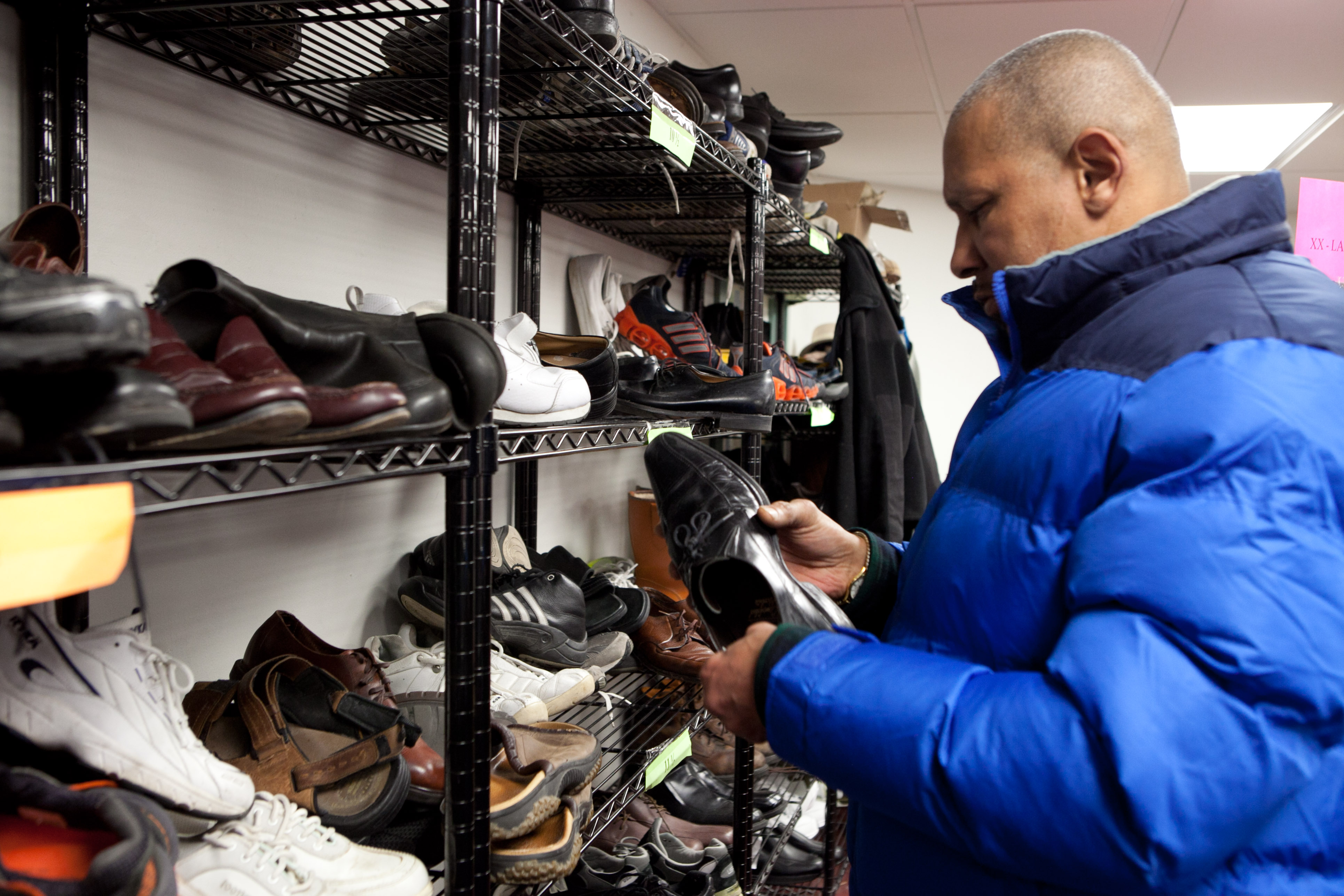
About two thirds of NECHV’s funding comes from public sources and the rest from private donations. Donations of clothing and essentials stock the center store where residents can take what they need from racks of suits for job interviews, packages of socks, long underwear, and rows of toiletries. Volunteers come in groups and as individuals to staff the lunch lines each day. And the center’s 100-year-old building in the heart of Boston recently got a facelift thanks to a crew of volunteers from Home Depot’s Aprons in Action program.

In addition to providing emergency and temporary shelter for clients, the center houses 60 veterans in permanent apartments. Residents receive meals, a mailing address, access to a laundry room, and supplies from the center store.

Any veteran, regardless of housing status, can participate in support groups, get a hot lunch, and receive job training. Staffers and volunteers assist NECHV clients in online job hunting, applying for subsidized housing, and researching educational opportunities.